Karnataka’s investment story has entered a striking new phase. Foreign direct investment into the state nearly doubled during FY2025–26, rising from US$6.62 billion in the previous financial year to approximately US$12.94 billion. The surge was the strongest increase among India’s major states and consolidated Karnataka’s position as the country’s second-largest destination for FDI, behind Maharashtra. The numbers are significant not simply because of their scale, but because of what they reveal about changing investor priorities. Global companies are becoming increasingly selective about where they commit long-term capital. Access to skilled professionals, digital infrastructure, reliable connectivity, research capabilities and an ecosystem capable of supporting large-scale operations have become decisive factors in investment decisions. Karnataka already possesses many of these advantages. Bengaluru’s decades-old technology ecosystem gives the state a powerful starting point, while its expanding network of Global Capability Centres, startups, research institutions and technology companies provides investors with an unusually deep business environment. The latest FDI surge suggests that Karnataka is increasingly converting these structural strengths into a broader investment proposition.
The Technology Foundation Behind the Boom

Few Indian states possess a digital economy comparable in scale to Karnataka’s. It figures presented at the State Level Export Promotion Committee meeting showed that Karnataka accounts for around 41 per cent of India’s software exports. The state also represents approximately 24 per cent of the country’s overall exports, while ranking fourth in merchandise exports with a share of about 7.78 per cent. These figures illustrate why Karnataka continues to attract international technology investment. Bengaluru has evolved far beyond its original identity as an outsourcing and software-services centre. Today, its ecosystem stretches across artificial intelligence, cloud computing, semiconductor design, biotechnology, fintech, aerospace, enterprise software, research and development, and Global Capability Centres. For multinational companies, this concentration creates a powerful network effect. Companies investing in Karnataka do not simply gain office space; they enter an ecosystem containing experienced engineers, entrepreneurs, universities, venture capital, specialised suppliers and other global corporations. The next challenge is to ensure that this advantage continues as the global technology industry shifts towards artificial intelligence.
From the Software Era to the AI Era

Chief Minister D.K. Shivakumar has placed artificial intelligence at the centre of Karnataka’s next economic chapter. His argument is essentially that Karnataka must use the foundations created during its software boom to establish leadership in the emerging AI economy. The ambition is considerable. Rather than treating artificial intelligence as another technology sector, the government is attempting to create what it describes as an “AI-native Karnataka”—an ecosystem combining education, computing infrastructure, research, startups, public services and private investment. The strategy also builds on an enormous existing economic base. Karnataka’s 41 per cent share of India’s software exports provides the state with a large pool of technology professionals who can potentially move into AI engineering, data science, machine learning and advanced digital services. For global investors, that transition is important. The next generation of technology investment will increasingly depend on access not only to programmers, but also to specialised AI researchers, cloud infrastructure, computing capacity and large pools of technically trained workers. Karnataka is trying to position itself ahead of that shift.
An AI University at the Heart of the Strategy

One of the most ambitious proposals is the establishment of what the government has described as India’s first government-driven dedicated Artificial Intelligence University in Bengaluru. The institution is expected to be developed with industry participation and focus on specialised AI education, research and collaboration. The proposal represents more than the creation of another university. If implemented effectively, it could become an important bridge between academic research and the rapidly changing requirements of the technology industry.
Artificial intelligence is advancing at a speed that traditional university programmes can struggle to match. Companies increasingly require expertise in machine learning, data engineering, AI infrastructure, robotics, cybersecurity and deployment of AI systems. A specialised institution closely connected with industry could help Karnataka build this talent domestically while attracting researchers and partnerships from outside the state. Important details—including curriculum, implementation schedules and training frameworks—are still to be developed. The institution’s eventual impact will therefore depend heavily on execution and the depth of industry participation.
Taking Artificial Intelligence to North Karnataka

The AI strategy is also beginning to move beyond Bengaluru. The Karnataka Cabinet has approved a Centre of Excellence in Artificial Intelligence at the Indian Institute of Information Technology, Raichur. The project has an outlay of ₹12 crore over five years, including ₹5 crore allocated through the 2026–27 State Budget and another ₹7 crore through the LEAP programme. Its location is particularly significant. The centre is intended to function as a regional AI hub serving 13 districts of North Karnataka, supporting education, research, innovation and entrepreneurship. That could allow emerging technologies to address problems relevant to industries and communities outside Bengaluru while creating opportunities for students and entrepreneurs who might otherwise have to relocate to the state capital.
In the longer term, initiatives such as the Raichur centre could help create smaller technology clusters across Karnataka rather than concentrating the digital economy almost entirely within Bengaluru.
The proposed AI University, green data centres, school-level AI education, IIIT Raichur Centre of Excellence and Beyond Bengaluru strategy suggest that the state is attempting exactly that.
Building the Infrastructure Behind AI

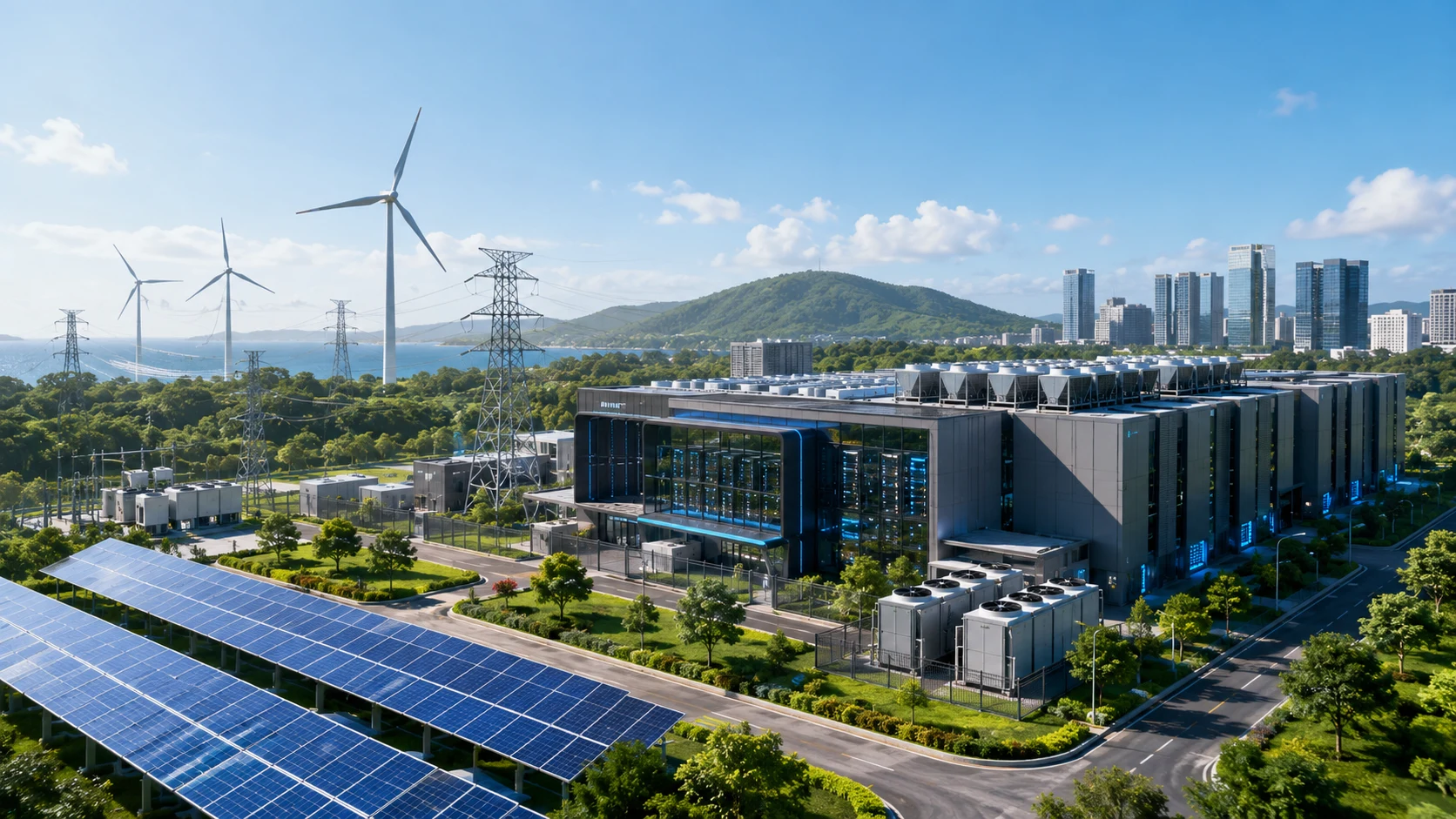
Talent alone, however, cannot create an AI economy. Modern artificial intelligence requires enormous computing resources, reliable electricity, sophisticated data infrastructure and high-speed connectivity. Karnataka’s strategy therefore includes plans for two next-generation green data centres—one near Bengaluru and another in a coastal district. The sustainability element is particularly relevant. Data centres consume substantial quantities of electricity and require extensive cooling infrastructure, making energy efficiency an increasingly important consideration for governments and technology companies. Locating new computing infrastructure alongside renewable-energy opportunities could strengthen Karnataka’s ability to attract hyperscale cloud and AI investments while managing some of the environmental pressures associated with rapidly expanding digital infrastructure. For the wider economy, the implications extend beyond technology companies. Large data-centre developments generate demand for power infrastructure, construction, engineering, cooling systems, networking equipment, real estate and specialised maintenance services. AI investment can therefore create economic activity across a much wider industrial ecosystem.
Building the Talent Pipeline from School

Karnataka is also looking much further ahead. The government has announced plans to introduce foundational AI education beginning from Class VI, signalling an attempt to familiarise students with emerging technologies much earlier in their education. The scale of such an initiative will require careful implementation. Teacher preparation, curriculum design, digital access and differences between urban and rural schools will all determine its effectiveness. Yet the underlying objective is strategically important. If artificial intelligence becomes embedded across industries—from healthcare and manufacturing to agriculture, finance and government—AI literacy may increasingly become a basic workforce skill rather than a specialist qualification. Creating that familiarity early could eventually give Karnataka another advantage in the competition for technology talent.
Spreading the Technology Economy

Perhaps the most important structural element of Karnataka’s emerging strategy is the effort to spread investment outside its capital. For decades, Bengaluru has been both Karnataka’s greatest economic strength and one of its biggest development challenges. The city’s success has attracted millions of workers and thousands of companies, but rapid growth has also placed enormous pressure on transport, housing, water and urban infrastructure. The government’s “Beyond Bengaluru” approach seeks to encourage technology investment and innovation in tier-two and tier-three cities. Cities such as Mysuru, Mangaluru, Hubballi-Dharwad, Belagavi, Kalaburagi and emerging centres in North Karnataka offer different combinations of educational institutions, industrial capabilities and lower operating costs. Developing these locations would give companies alternatives to Bengaluru while potentially distributing employment, entrepreneurship and infrastructure investment more evenly across the state. The Raichur AI Centre provides an early indication of how this decentralised technology strategy could work.
From FDI Destination to Complete Innovation Ecosystem

Karnataka’s near-doubling of FDI is an important vote of confidence, but the bigger story lies in what the state does next. The strongest investment destinations of the coming decade are unlikely to compete solely through incentives or inexpensive land. They will compete through ecosystems—talent, universities, research, energy, digital infrastructure, connectivity, startups and quality of governance. Karnataka already has one of India’s strongest technology foundations. Its challenge now is to convert Bengaluru’s extraordinary concentration of knowledge and capital into a broader state-wide economic advantage.
The proposed AI University, green data centres, school-level AI education, IIIT Raichur Centre of Excellence and Beyond Bengaluru strategy suggest that the state is attempting exactly that. Execution will ultimately determine whether these announcements translate into lasting economic transformation. Infrastructure constraints, sustainability, regional disparities and the enormous demand for specialised talent remain significant challenges. But the direction is becoming increasingly clear.
Karnataka’s first technology revolution made Bengaluru synonymous with India’s software industry. Its next ambition is larger: to combine artificial intelligence, digital infrastructure, global investment and regional development into a new economic model. With nearly US$13 billion in annual FDI already flowing into the state, investors appear to be paying attention.